
Headless CMS and Omnichannel Content Delivery
How Headless CMS Enables Consistent, Flexible Content Experiences Across Websites, Apps, and Digital Channels
Headless CMS and Omnichannel Content Delivery
Customers interact with brands through more than just websites. They may use mobile apps, ecommerce stores, customer portals, digital displays, and other digital experiences. Managing content separately for each channel can create duplication and make updates difficult to control. A Headless CMS provides a way to manage structured content centrally and make it available to different applications through APIs.
However, omnichannel delivery does not mean displaying exactly the same content or design everywhere. Instead, the goal is to reuse appropriate content across channels while allowing each channel to provide its own user experience.
What Is Omnichannel Content Delivery?
Omnichannel content delivery means making relevant content available across multiple digital channels from a controlled content source. In a Headless CMS, content is managed independently from the frontend and can be requested by different applications through delivery APIs.
For example, a company could manage a product announcement in its CMS and make the relevant information available to its website, mobile app, and customer portal. Each application can then decide which fields it needs and how the content should be displayed.
This approach reduces unnecessary duplication while keeping presentation responsibilities within the individual applications.
How Headless CMS Supports Omnichannel Delivery
A typical Headless CMS setup separates the content management layer from the applications that consume the content.
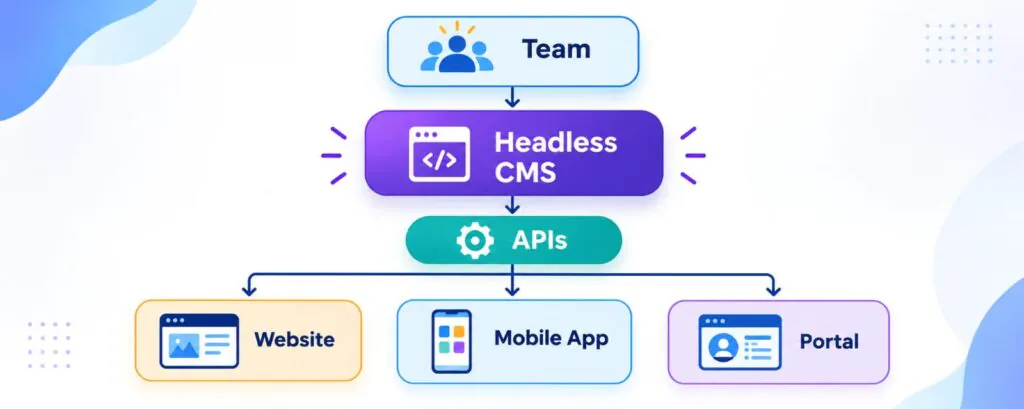
The CMS manages the content, while each frontend determines how that content should be presented. Depending on the platform, content may be accessed through REST, GraphQL, or another API mechanism.
This separation allows different applications to use the same content without requiring the CMS to control their layouts or frontend technologies.
Reuse Content Without Duplicating It
One of the biggest advantages of an omnichannel approach is content reuse. Instead of creating separate copies of the same information for every channel, teams can maintain shared content centrally and allow applications to consume the fields they need.
For example, a product announcement might contain:
- Title
- Summary
- Description
- Image
- Publication date
- Related content
A website might display all of these fields, while a mobile application might use only the title, summary, and image.
The underlying content can remain centralized while each channel creates an experience appropriate for its users.
APIs Connect the CMS to Digital Channels
APIs are a key part of Headless CMS delivery. They allow applications to request published content programmatically rather than relying on a CMS-controlled presentation layer.
A web application might request article content, while a mobile application requests the same article through the CMS’s supported API. The applications then transform the returned data into their respective interfaces.
When selecting a Headless CMS, organizations should consider API capabilities such as:
REST or GraphQL support
How applications access and retrieve CMS content
Authentication and authorization
How API access and content permissions are secured
Filtering and querying
How applications retrieve only the content they need
Localization
How APIs deliver content for different languages and regions
Rate limits
How API usage is controlled and scaled
Caching behavior
How frequently requested content is stored and delivered efficiently
Preview capabilities
How applications access unpublished or draft content before release
The exact capabilities differ between CMS platforms, so these should be evaluated against the requirements of the applications consuming the content.
Webhooks Can Automate Content Updates
APIs allow applications to retrieve content, while webhooks can notify other systems when content-related events occur, where the CMS supports them.
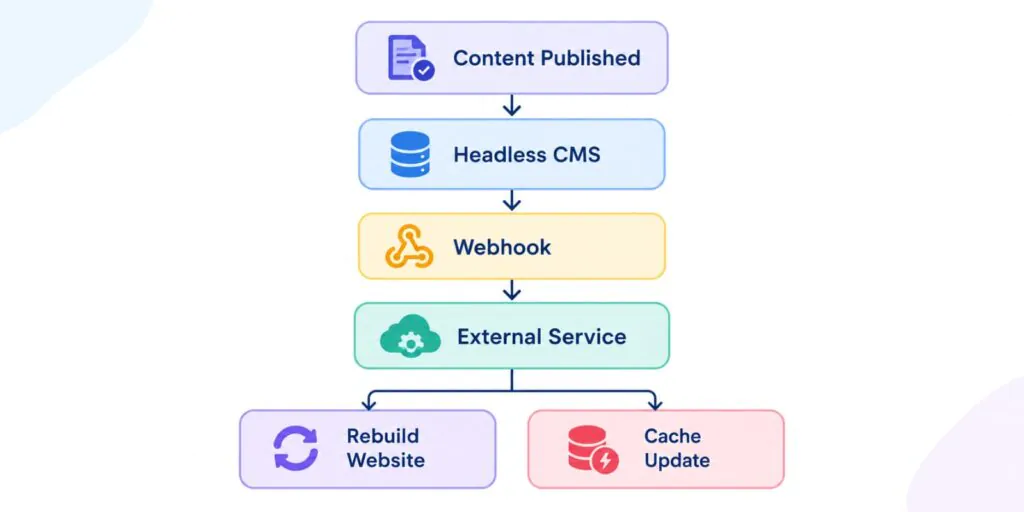
A webhook could trigger a website rebuild, cache invalidation, or another downstream process.
However, webhooks should not be treated as guaranteed one-time delivery. Production implementations should account for authentication, retries, duplicate events, failures, and idempotent processing.
Omnichannel Content and Localization
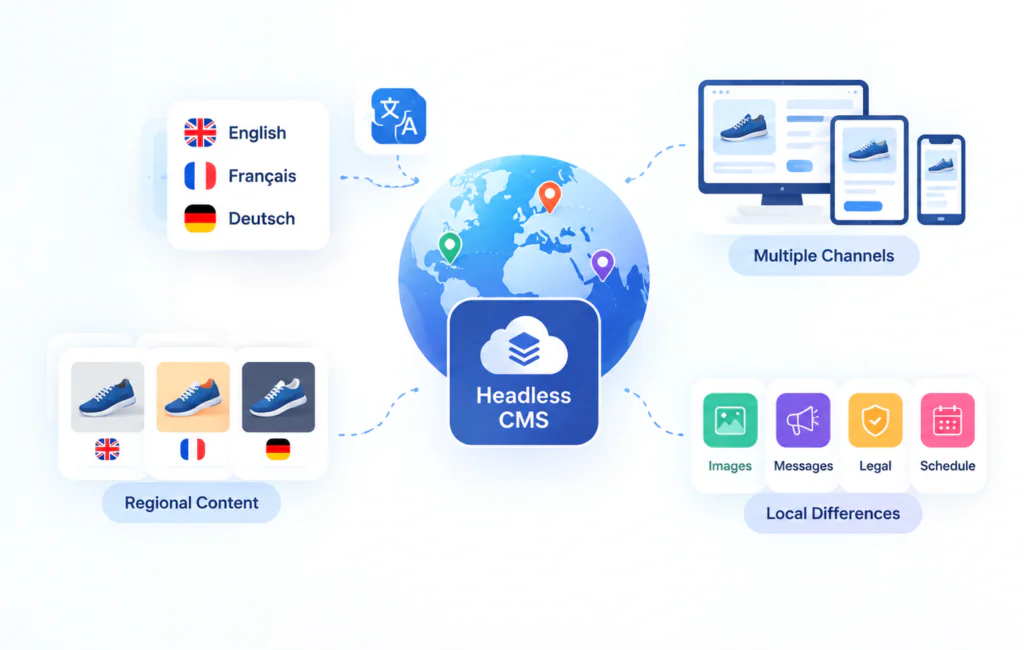
Global organizations often need to deliver content in multiple languages and regions. A Headless CMS can support localized versions of content, depending on the platform.For example, the same product information may have English, French, and German versions. Applications can request the appropriate locale and present the relevant content to users.
Localization can involve more than translation. Different markets may require different images, promotional messages, legal information, or publishing schedules.
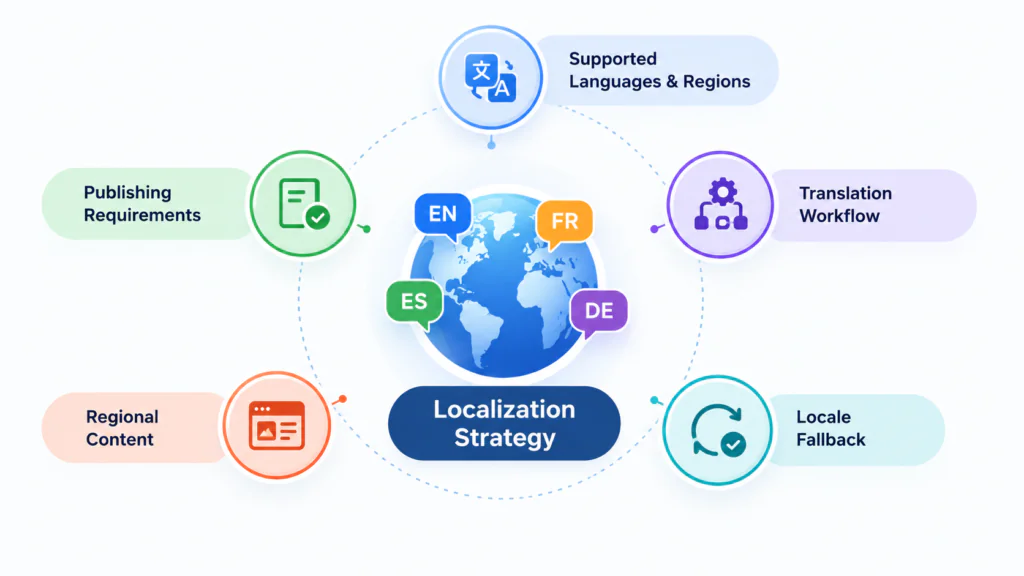
A good localization strategy should define:
- Supported languages and regions
- Translation workflow
- Locale fallback behavior
- Regional content variations
- Publishing requirements
These capabilities and behaviors vary between CMS platforms and should be verified during implementation.
Performance Considerations
Omnichannel delivery also requires careful attention to performance. Applications depend on the availability and response time of the content APIs, particularly when content is requested dynamically.Caching can reduce repeated requests and improve response times. Depending on the application architecture, caching may occur at the CDN, application, framework, or API layer.
Teams should consider cache invalidation, API rate limits, payload size, image optimization, and failure handling when designing the delivery architecture.The appropriate strategy depends on how frequently content changes and how quickly published changes need to become visible.
Common Omnichannel Challenges
A Headless CMS makes content reuse easier, but it does not automatically solve every omnichannel problem. Organizations still need to define how content should be shared, how applications consume it, and how updates propagate through the delivery stack.
Common challenges include:
- Keeping content consistent across channels
- Managing localized content
- Handling API failures
- Controlling caching and invalidation
- Managing API access securely
- Supporting different channel requirements
- Monitoring content delivery
Clear ownership between the CMS, frontend applications, and integration services is important for maintaining a reliable system.
Best Practices for Omnichannel Content Delivery
A successful implementation should focus on reusable content and independent presentation. Content should represent meaningful information rather than being tightly tied to a specific page layout.
Organizations should also establish clear technical responsibilities between the CMS and consuming applications.
Area | Recommended Approach |
Content | Manage reusable structured content centrally |
Presentation | Let each channel control its own UI |
APIs | Use supported delivery APIs |
Caching | Define clear caching and invalidation rules |
Webhooks | Handle retries and duplicate events |
Localization | Define locale and fallback behavior |
Security | Protect API credentials and access |
Monitoring | Track API errors and delivery performance |
Conclusion
Headless CMS and omnichannel content delivery provide a flexible approach to managing content across multiple digital experiences. A centralized CMS can provide structured content through APIs, while websites, mobile applications, ecommerce storefronts, and other channels can consume that content according to their individual requirements.
The goal is not to make every channel look identical. It is to manage reusable content centrally while allowing each digital experience to control its own presentation.
With appropriate API design, caching, localization, webhooks, security, and monitoring, organizations can build an omnichannel content system that is easier to maintain and capable of supporting new digital experiences as their needs evolve.