
Headless CMS and AI: How AI Is Transforming Content Management
Explore how artificial intelligence is transforming the way businesses create, manage, and deliver digital content. By combining AI with Headless CMS platforms, organizations can automate content workflows, improve content discovery, and deliver more relevant digital experiences. From content generation and intelligent search to personalization and recommendations, AI is introducing new possibilities for modern content management. This approach helps businesses build smarter, more flexible, and scalable digital experiences.
Headless CMS and AI: How AI Is Transforming Content Management
Artificial intelligence is changing the way businesses create, organize, and deliver digital content. At the same time, Headless CMS platforms have made it easier to manage content independently from the frontend applications that display it. Bringing these technologies together allows organizations to automate repetitive content operations, improve content discovery, and create more intelligent digital experiences.
A Headless CMS and AI serve different purposes within a modern content architecture. The CMS manages structured content and exposes it through APIs, while AI services can analyze, generate, classify, translate, or enrich that content. An application or integration layer connects these systems and determines when AI should be used, what information should be processed, and where the resulting data should go.
What Is a Headless CMS?
A Headless CMS is a content management system that separates the content repository from the presentation layer. Instead of controlling how content is displayed on a specific website, it stores structured content and makes that content available through APIs such as REST or GraphQL.
This allows developers to use different frontend technologies while keeping content management centralized. The same content can be delivered to websites, mobile applications, digital products, and other channels without creating separate content repositories for each experience.This API-first architecture also makes it easier to connect external services. AI, search, analytics, recommendation, and other specialized systems can consume content through APIs without requiring the CMS to handle every application responsibility.
How AI Works With a Headless CMS
AI is generally introduced as an additional service rather than being treated as a replacement for the Headless CMS. The CMS remains responsible for storing and managing structured content, while an AI service performs a specific task such as generating a summary, suggesting metadata, classifying content, or creating embeddings for semantic search.
For example, when an editor publishes or updates an article, the CMS can trigger a webhook. An application service can receive that event, send selected content to an AI service, validate the response, and then store the result in the CMS or another appropriate system.
A simplified architecture looks like this:
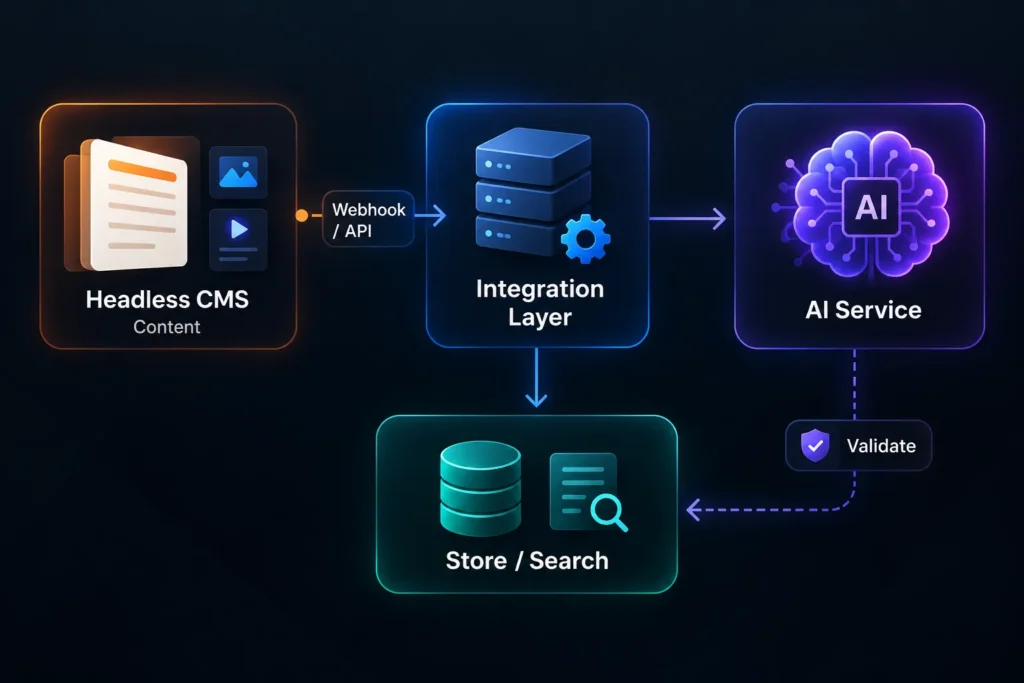
Keeping these components separate provides flexibility. An organization can change an AI model or provider without necessarily changing the CMS or rebuilding the frontend applications.
AI-Powered Content Creation
Generative AI can assist content teams with many repetitive content tasks. It can produce initial drafts, summaries, product descriptions, headlines, FAQs, and other structured content based on defined requirements.A Headless CMS can make this process more controlled by defining exactly which fields AI can assist with. For example, a product content model could contain fields for a product summary, description, features, SEO title, and SEO description. An AI service can generate suggestions for these fields while the editorial workflow determines whether they are approved for publication.
AI-generated content should not automatically be treated as verified information. Human review can remain an important part of the workflow, particularly for technical, legal, financial, medical, or brand-sensitive content.
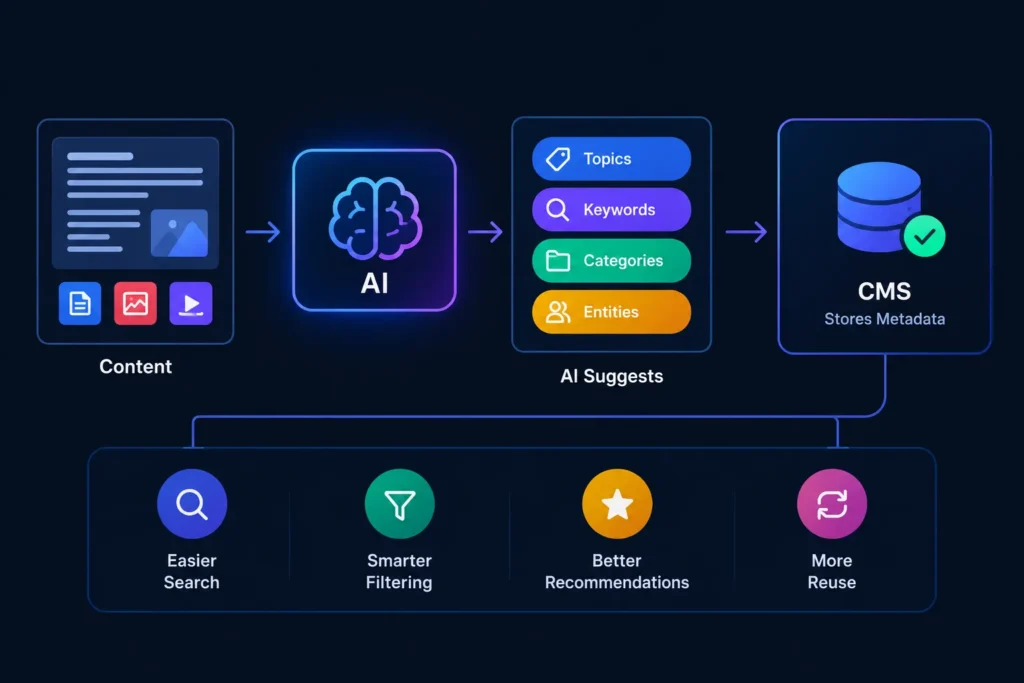
AI for Content Tagging and Classification
As content libraries become larger, manually organizing every article, product, document, or media asset can become difficult. AI can analyze content and suggest categories, topics, keywords, entities, and other metadata.For example, an AI service could analyze a technical article and identify topics such as APIs, web development, cloud computing, and content management. These results can then be validated and stored as structured metadata in the CMS.
This improves more than content organization. Consistent metadata can also make content easier to filter, search, recommend, and reuse across different digital channels.
AI-Powered Search and Content Discovery
Traditional search often depends heavily on keyword matching. AI-powered semantic search can understand the meaning and context of a query, allowing users to find relevant content even when the exact words used in the query do not appear in the content.A common implementation uses embeddings. Content is converted into numerical representations using an embedding model and stored in a vector-capable search or database system. When a user submits a search query, the query can also be converted into an embedding and compared with the stored representations.
The search system can then return relevant content from the CMS. In a Retrieval-Augmented Generation (RAG) architecture, retrieved content can also be provided as context to an AI model before it generates a response.
AI-Powered Recommendations and Personalization
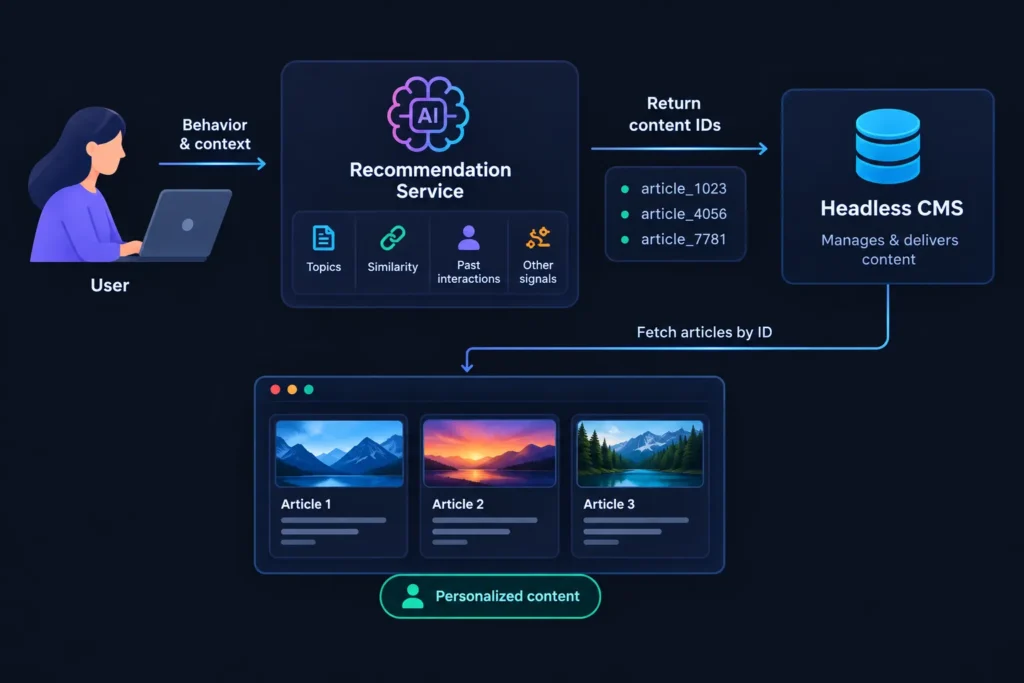
AI can help organizations deliver more relevant content by analyzing content relationships and user interaction signals. A recommendation system can consider content topics, semantic similarity, previous interactions, and other signals to determine relevant content.A Headless CMS is not necessarily a personalization engine. The CMS manages and delivers content, while a separate application or recommendation service determines what content is relevant for a particular user or context.
For example, a recommendation service can identify related articles and return their content IDs. The frontend can then retrieve those articles from the Headless CMS API and display them to the user.
AI-Assisted Content Workflows
AI can also be integrated into publishing and content operations. Webhooks can notify an application whenever content is created, updated, or published. The application can then trigger an AI workflow for tasks such as summarization, classification, metadata generation, or translation.
For production systems, AI processing can be handled asynchronously using queues or background workers. This prevents slow AI operations from blocking the main CMS workflow and makes it easier to handle retries, failures, and rate limits.
A typical workflow can be:
Content Update
Content is created or updated in the Headless CMS.
Webhook Trigger
The CMS sends a webhook event.
Event Reception
An integration service receives the event.
AI Job Creation
An AI processing job is created.
AI Processing
The AI service processes the required content.
Response Validation
The response is validated.
Result Storage & Approval
The result is stored, indexed, or sent for editorial approval.
AI-Assisted Multilingual Content
AI can also support multilingual content management by providing initial translations for articles, product descriptions, documentation, and other content. The translated content can then be stored as localized fields or separate localized entries, depending on the CMS architecture.
Automated translation can reduce the time required to create multiple language versions, but it should not always replace human review. Technical terminology, brand language, legal information, and regional expressions may require additional review before publication.A controlled workflow allows AI to accelerate translation while keeping editorial teams responsible for final quality and accuracy.
Security Considerations
Adding AI to a Headless CMS introduces additional security considerations. Content sent to an external AI service may contain sensitive information, while content retrieved from external or user-generated sources may contain instructions designed to manipulate an AI model.
Prompt injection is one example of this risk. If an AI service processes untrusted CMS content, an attacker could potentially include instructions intended to influence how the model behaves. For this reason, external and user-generated content should be treated as untrusted input.Security controls should also be enforced by the application rather than relying on the AI model to make authorization decisions. API keys, permissions, validation, and access controls should remain under explicit application control.
Important practices include:
Credential Security
Protect AI and CMS API credentials.
Least Privilege
Use least-privilege permissions for integrations.
Output Validation
Validate AI-generated output before using or storing it.
Untrusted Input
Treat external and user-generated content as untrusted input.
Human Approval
Use human approval for high-impact publishing operations.
Activity Monitoring
Monitor AI requests, failures, and unusual activity.
Technical and Operational Challenges
Although AI can improve content operations, integrating it into a production content platform introduces additional considerations. AI services can have usage limits, variable response times, changing model behavior, and associated processing costs.
AI-generated output can also be inaccurate or inconsistent. Applications should therefore define validation rules and fallback behavior instead of assuming that every AI response is correct. Monitoring and evaluation are particularly important when AI is involved in customer-facing content.Organizations should also evaluate how their AI provider handles submitted data, what information is retained, where it is processed, and what contractual or regulatory requirements apply to the content being sent.
Benefits of Combining Headless CMS and AI
The combination of Headless CMS and AI can improve both content operations and digital experiences. AI can reduce repetitive manual tasks while helping teams generate metadata, classify content, improve search, translate content, and identify relevant recommendations.
The API-driven nature of a Headless CMS also supports incremental adoption. Organizations can introduce one AI capability without redesigning the entire platform and can add additional capabilities as their requirements evolve.
Key benefits include:
Area | Potential benefit |
Content operations | Automates repetitive tasks |
Content discovery | Improves search and recommendations |
Content creation | Assists with drafts and structured content |
Localization | Accelerates initial translation |
Content organization | Automates metadata and classification |
Architecture | Keeps AI services separate from the CMS |
The Future of Headless CMS and AI
The combination of Headless CMS and AI is creating new possibilities for how organizations manage and deliver content. AI can help systems understand content, automate repetitive processes, improve search, and support more contextual digital experiences.
However, AI should be treated as an additional capability rather than a replacement for the CMS or the content team. A reliable architecture keeps content management, authorization, validation, and publishing controls under explicit system control while using AI where probabilistic processing can provide value.As AI technologies continue to evolve, organizations can add new AI services around their existing API-driven content infrastructure. This makes it possible to experiment with new capabilities while keeping the underlying content architecture flexible and maintainable.
Conclusion
Headless CMS and AI complement each other by addressing different parts of modern content management. The Headless CMS provides structured content and API-based delivery, while AI can add capabilities such as content generation, classification, semantic search, recommendations, and translation assistance.
The most effective approach is to connect these technologies through APIs, webhooks, and application services while maintaining validation, security, and editorial controls. By starting with practical use cases and expanding gradually, organizations can build intelligent content experiences without sacrificing the flexibility and control provided by a Headless CMS.