
Headless CMS Content Governance: Managing Workflows, Roles, and Approvals
Streamlining Content Operations with Structured Workflows, Clear Roles, and Efficient Approval Processes
Introduction
A Headless CMS gives organizations flexibility to manage content independently from the presentation layer. As content is delivered through APIs to websites, mobile applications, and other digital experiences, teams need clear processes for managing that content. Content governance provides those processes by defining how content is created, reviewed, approved, published, maintained, and retired.
Effective governance helps organizations maintain content quality and accountability without limiting the flexibility of a Headless CMS. It establishes clear responsibilities for content teams and creates consistent publishing processes. This becomes increasingly important when multiple authors, editors, business teams, and digital channels use the same content platform.
What Is Content Governance in a Headless CMS?
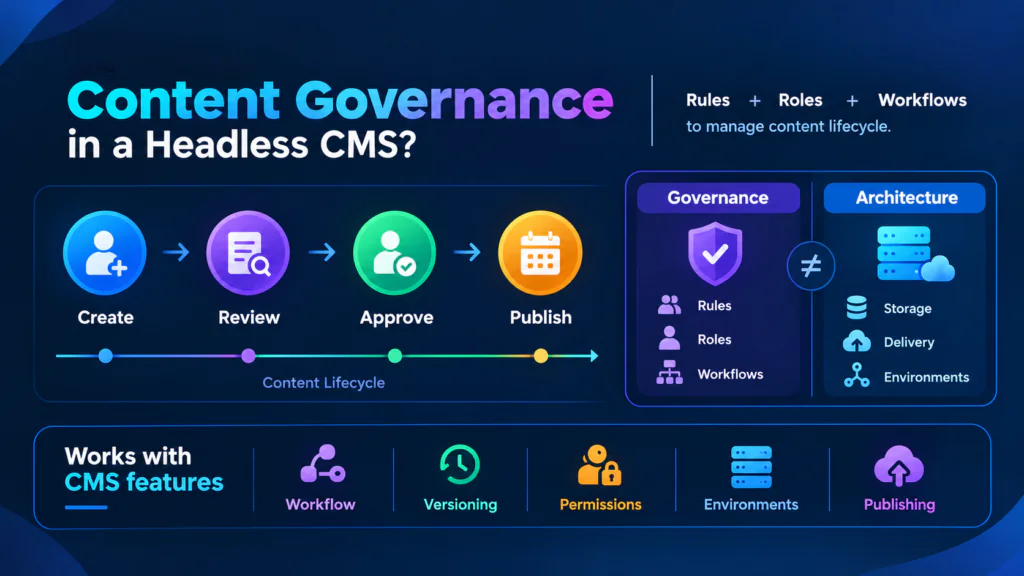
Headless CMS content governance is the framework of rules, responsibilities, workflows, and processes used to manage content throughout its lifecycle. It determines who can create or modify content, which content requires review, who can approve it, and when it can be published.
Governance is different from the CMS architecture itself. The architecture defines how content is stored and delivered, while governance defines how teams manage that content operationally. A well-designed governance model works alongside the CMS’s workflow, versioning, permissions, environments, and publishing capabilities.
Why Content Governance Matters
Without clear governance, content operations can become inconsistent as teams and content volumes increase. Multiple users may make changes without a defined review process, or teams may be uncertain about who owns specific content. These issues can result in outdated information, duplicate content, or inappropriate publishing decisions.
Governance creates a repeatable process for managing these situations. It gives teams clear ownership and approval responsibilities while helping organizations maintain content quality across different digital experiences. The goal is to provide appropriate control without creating unnecessary delays.
How Content Governance Works in a Headless CMS
A typical governance process manages content from creation through publication and ongoing maintenance. The exact workflow depends on the organization’s requirements and the capabilities of its Headless CMS.
For example, an author can create or update content in a draft state. An editor can review the content and request changes, while an authorized person can approve it for publication. Once published, the content can be delivered through the CMS API to the applications or websites that consume it.
A Typical Content Lifecycle
A structured workflow from creation to retirement
Not every content type needs the same workflow. High-impact or regulated content may require additional review, while low-risk content may follow a simpler process.
Managing Roles and Responsibilities
Content governance should clearly define responsibilities for each stage of the content lifecycle. A Headless CMS may provide roles and permissions, but organizations should first determine the responsibilities required by their editorial process.
For example, authors may create content, editors may review and refine it, and publishers may have authority to release approved content. In larger organizations, legal, compliance, product, or brand teams may participate in specific approval workflows.
Role | Typical Responsibility |
Author | Creates and updates content |
Editor | Reviews and improves content |
Subject Matter Expert | Validates technical or business accuracy |
Approver | Confirms content is ready for publication |
Publisher | Publishes approved content |
Administrator | Manages CMS configuration and platform access |
Roles should be adapted to the organization’s actual operating model. A small team may combine several responsibilities, while an enterprise organization may separate them across departments.
Content Workflows and Approvals
Workflows provide a defined path for content before it becomes published. They help ensure that content reaches the appropriate reviewers and approval stages before being made available to consuming applications.
Approval requirements should depend on the type and importance of the content. For example, a marketing campaign may require brand approval, while regulated content may require compliance review. A simple internal update may need only an editorial review.A good workflow should provide enough control without introducing unnecessary approval steps. Excessive stages can slow publishing, while insufficient review can increase the chance of inaccurate or unsuitable content reaching production.
Content Versions and Changes
Version management is an important part of governance because content can change throughout its lifecycle. Teams may need to review previous versions, identify what changed, or restore an earlier version when supported by the CMS.Governance should define how significant content changes are handled. For example, minor editorial corrections may require normal review, while substantial changes to important content may require additional approval.
Version history also supports accountability by providing a record of how content has evolved over time, depending on the capabilities of the chosen Headless CMS.
Environments and Publishing Control
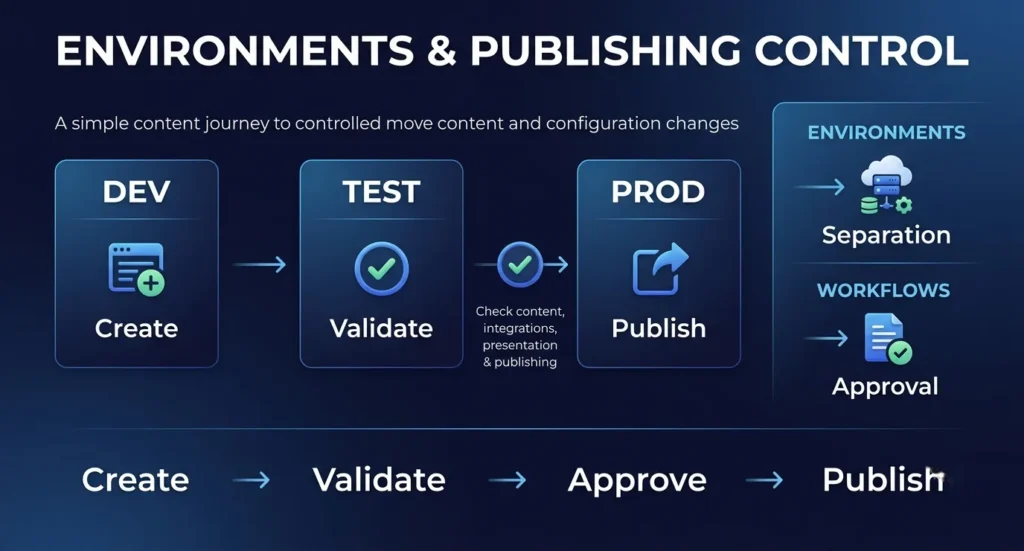
Many Headless CMS implementations use separate environments or stages for development, testing, and production. Governance should define how content and configuration changes move between these environments.
Content should be validated in the appropriate environment before production publication to identify content, integration, or presentation issues. However, environments and workflows are not identical concepts. Environments provide separation for development and deployment activities, while workflows define the editorial process used to review and approve content.
Content Ownership and Accountability
Every important content area should have a clearly identified owner or responsible team. Ownership determines who is responsible for maintaining accuracy, reviewing outdated information, and deciding whether content should remain published.Ownership can be organized by content type, product, department, market, or business function. Clear ownership is particularly important when the same content is reused across multiple digital channels.
Governance Across Multiple Channels
A Headless CMS can distribute the same content through APIs to different applications and digital experiences. This makes governance important because a single content update may affect more than one channel.Teams should understand where content is consumed before making significant changes. Governance can define review requirements for shared content and establish responsibility for maintaining content that is reused across multiple experiences.
This is especially useful for organizations managing websites, mobile applications, portals, and other API-driven experiences from a centralized content platform.
Content Lifecycle Management
Governance should continue after content is published. Published content may become outdated, require revision, or no longer serve a business purpose.
Organizations can define lifecycle rules for reviewing, updating, archiving, or retiring content. Regular content reviews help prevent outdated information from remaining available indefinitely.
A Basic Lifecycle Governance Process
A structured governance process helps maintain content quality, ownership, accuracy, and relevance throughout its lifecycle.
Content Governance Best Practices
Effective governance should be practical and scalable. Organizations should define only the controls needed to maintain content quality, accountability, and publishing consistency.The governance model should also evolve as the organization grows. New teams, content types, markets, and digital channels may require additional workflows or ownership rules.
Key best practices include:
- Define clear content ownership.
- Separate content creation, review, and approval where appropriate.
- Create workflows based on content risk and business requirements.
- Use appropriate roles and permissions.
- Establish rules for version and lifecycle management.
- Define how content moves toward production.
- Review and retire outdated content regularly.
- Document governance policies and responsibilities.
Common Content Governance Challenges
One common challenge is creating workflows that are either too simple or unnecessarily complex. A workflow with no meaningful review can reduce content quality, while too many approval stages can slow down publishing and frustrate content teams.
Another challenge is unclear ownership. When no team is responsible for maintaining a content area, outdated or duplicate content can accumulate. Organizations should therefore regularly evaluate workflows, ownership, and lifecycle policies to ensure governance remains effective.
Governance vs. Security
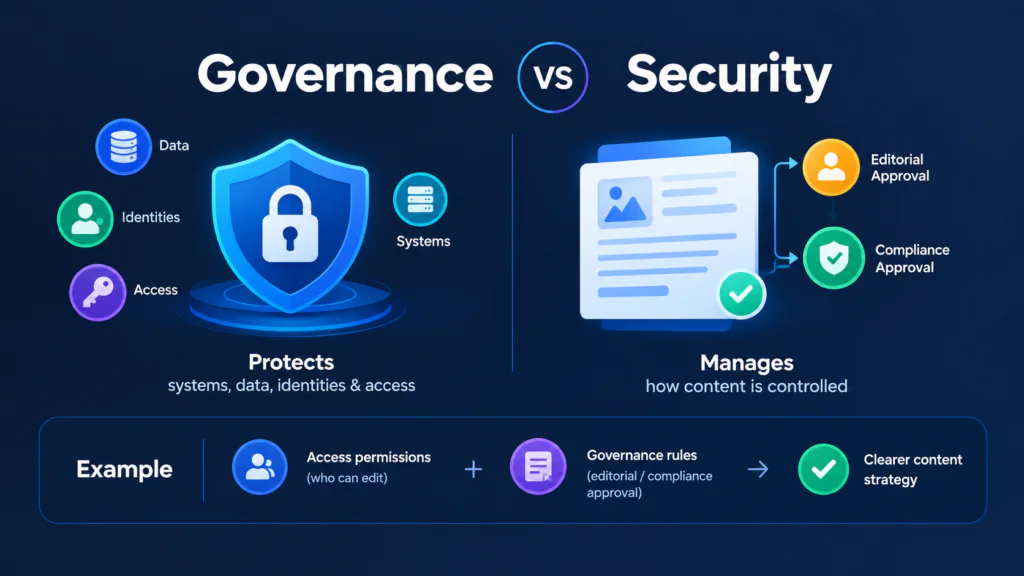
Content governance and security are related but serve different purposes. Security focuses on protecting systems, data, identities, and access, while governance focuses on how content is managed and controlled throughout its lifecycle.
For example, access permissions can determine who is allowed to edit content, while governance determines whether that content should require editorial or compliance approval before publication. Keeping these concepts separate makes the overall content management strategy clearer.
Conclusion
Headless CMS content governance provides a structured approach to managing content from creation through publication and retirement. By defining workflows, roles, ownership, approvals, and lifecycle processes, organizations can maintain content quality while allowing teams to work efficiently.
The most effective governance model is not necessarily the most complex one. It should match the organization’s content requirements, risk level, team structure, and publishing processes. With the right governance framework, organizations can use the flexibility of a Headless CMS while maintaining consistent and accountable content operations.