
Headless CMS Content Federation: A Complete Guide to Unifying Multiple Content Sources
Unify content from multiple CMS platforms, APIs, and external services into a single, seamless digital experience. Discover the architecture, benefits, best practices, and implementation strategies for building scalable headless content federation solutions.
Introduction
Modern digital platforms often store content across multiple CMS platforms, product information systems, digital asset management platforms, and external APIs. Accessing this information separately can increase development complexity and make it difficult to deliver consistent digital experiences. Headless CMS content federation provides an architectural approach to accessing and combining data from these independent sources through a unified application-facing interface. It allows organizations to connect existing systems without requiring all content to be migrated into a single repository.
What Is Headless CMS Content Federation?
Content federation is an architectural pattern that allows an application to access and combine content from multiple independent sources without necessarily centralizing the underlying data. Each source continues to manage its own content, while an integration layer retrieves the required information and presents it in a format suitable for the consuming application.
In a headless CMS environment, the integration layer may connect a CMS content API with product services, media platforms, or other business systems. The frontend consumes the aggregated response instead of implementing separate integrations for every source. Content federation is not a built-in capability of every headless CMS; it typically requires an appropriate API integration or orchestration layer.
How Does Content Federation Work?
Content federation generally uses API clients, connectors, or service adapters to communicate with independent systems. When an application requests a page, an aggregation layer determines which sources are needed, retrieves the relevant data, and maps their responses into a common application-facing structure. The frontend then uses this response to render the page.
Data can be retrieved at request time, cached for subsequent requests, or prepared in advance through background processing. The appropriate approach depends on freshness requirements, API performance, and source availability. Federation combines access to distributed information, but it does not automatically synchronize content or guarantee consistency across the underlying systems.
A typical workflow includes:
Source systems:
Content and data reside in separate CMS platforms, databases, or services.
Integration layer:
API clients or connectors retrieve information from the relevant sources.
Aggregation layer:
Data is transformed, validated, and combined into an application-facing response.
Caching and error handling:
Appropriate policies manage repeated requests, latency, and unavailable dependencies.
Frontend application:
The application consumes the response and renders the digital experience.
Key Benefits of Content Federation
Content federation enables organizations to connect existing platforms without requiring a complete content migration. Teams can continue using specialized systems while making relevant information available to a shared application. This is particularly useful when different departments own different content types or when replacing established systems would be expensive and disruptive.
It also supports incremental modernization by allowing organizations to introduce new applications around existing services. However, the benefits depend on API quality, integration complexity, and operational management. Federation can reduce migration effort, but it does not eliminate the need to maintain source systems and their integrations.
Key benefits include:
Reduced migration effort:
Existing content can remain in its original system.
Flexible integration:
Multiple services can contribute data to the same application.
Independent ownership:
Teams retain responsibility for their respective systems.
Simplified frontend access:
An aggregation layer can hide source-specific API differences.
Incremental modernization:
Individual systems can be upgraded or replaced independently.
Content Federation vs. Content Centralization
Content federation and content centralization represent different approaches to managing distributed information. Federation accesses content across independent systems, whereas centralization brings content into a shared repository. Federation is useful when systems need to remain independent, while centralization can simplify management when a common repository is desirable.
These approaches are not mutually exclusive. An organization may centralize editorial content in one CMS while federating product information, inventory, and other data from external services. The decision should be based on ownership requirements, data freshness, operational complexity, and the capabilities of the existing systems.
Aspect | Content Federation | Content Centralization |
Data storage | Remains distributed across sources | Consolidated in a shared repository |
Application access | Combined through an integration layer | Retrieved from the central repository |
Migration requirements | May avoid large-scale migration | May require content migration |
Data consistency | Depends on source behavior and integration policies | Central management can simplify consistency |
Operational complexity | Requires integration and dependency management | Requires central platform management |
Suitable scenario | Connecting independently managed systems | Consolidating content management |
Common Use Cases of Content Federation
Content federation is useful when a digital experience depends on information maintained by multiple systems. For example, an e-commerce website may use a headless CMS for editorial content, a product information management (PIM) system for product descriptions, and an inventory API for stock availability. An aggregation layer can combine the required information into a single response for a product page.
Other organizations can use federation to connect content across business units, brands, and specialized services. The key requirement is that each source exposes accessible data through an API or another supported integration mechanism. Federation then makes that data available to the application without requiring every source to use the same CMS.
Common use cases include:
- 🛒
E-commerce:
Combining product descriptions, editorial content, prices, and inventory data.
- 🏢
Corporate websites:
Accessing information managed by separate departments or business units.
- 🌐
Multi-brand platforms:
Connecting content from different CMS platforms.
- 👤
Customer portals:
Combining help articles with relevant customer or service information.
- 📰
Media platforms:
Integrating articles, media metadata, and digital asset information.
Technical Challenges and Best Practices
Content federation introduces challenges because different sources may have different schemas, authentication mechanisms, rate limits, and availability guarantees. A page that depends on multiple APIs can become slower if requests are executed sequentially or if one dependency responds slowly. The integration layer must therefore manage timeouts, request concurrency, and failures without allowing a single unavailable source to unnecessarily disrupt the entire experience.
Data freshness also requires careful planning. Caching reduces repeated API calls and latency, but cached responses may become outdated. Teams should define cache expiration and invalidation policies according to how frequently each source changes. Monitoring, access control, and clear data ownership are equally important for maintaining a reliable federation architecture.
Recommended practices include:
- 01
Normalize responses:
Map source-specific fields into a documented application-facing schema.
- 02
Secure integrations:
Apply authentication, authorization, and least-privilege access.
- 03
Optimize requests:
Parallelize independent API calls where appropriate and avoid unnecessary requests.
- 04
Manage caching:
Define suitable expiration and invalidation policies.
- 05
Handle failures:
Use timeouts, controlled retries, and fallbacks where appropriate.
- 06
Monitor dependencies:
Track latency, errors, rate limits, and availability.
- 07
Define data ownership:
Identify the authoritative source for each field or content type.
Content Federation and GraphQL
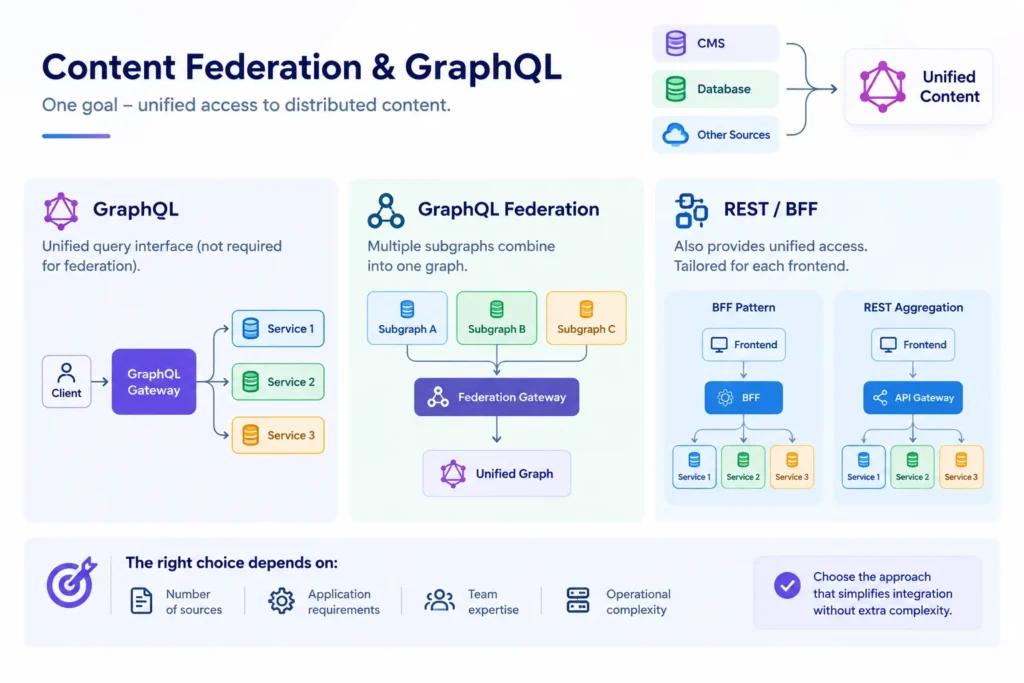
GraphQL can provide a unified query interface for federated content, but it is not required to implement content federation. A GraphQL gateway can retrieve and combine data from multiple services through resolvers or other integration mechanisms. GraphQL federation is a more specific architecture in which multiple subgraphs contribute to a composed graph, commonly using a federation-compatible gateway or router.
REST-based API aggregation and backend-for-frontend (BFF) patterns can also provide unified access to distributed content. A BFF can tailor responses to the needs of a particular frontend, while a GraphQL layer can let clients request specific fields. Neither approach automatically improves performance or data consistency; those outcomes depend on implementation, caching, query planning, and source behavior.
The right choice depends on the number of sources, application requirements, team expertise, and operational complexity. Organizations should choose an approach that simplifies integration without introducing unnecessary infrastructure.
How to Implement Headless CMS Content Federation
Implementation should begin with an inventory of content sources, their APIs, and their ownership boundaries. Teams should identify which system is authoritative for each type of information and define how the application will access it. This prevents conflicting ownership and makes it easier to determine how updates, errors, and data freshness should be handled.
Next, select an integration pattern based on the application’s needs. This could be a REST aggregation service, a BFF, or a GraphQL gateway. Build the necessary connectors and response mappings, then configure authentication, caching, timeouts, and monitoring. Test the system with realistic traffic and simulate dependency failures before deploying it to production.
A practical implementation process includes:
Identify the systems
Identify the CMS platforms, APIs, and external services to connect.
Define data and schema
Define data ownership and the application-facing response schema.
Select the aggregation approach
Select an aggregation approach, such as REST, BFF, or GraphQL.
Build the integrations
Implement API integrations, authentication, and data transformation.
Configure reliability
Configure caching, timeouts, and failure-handling policies.
Test the implementation
Test data accuracy, performance, and resilience.
Monitor and improve
Monitor production behavior and refine the integration as requirements evolve.
Conclusion
Headless CMS content federation enables organizations to build unified digital experiences using content and data from independently managed systems. By introducing an integration layer, applications can access distributed information without requiring every source to migrate to a single platform. This supports flexible architectures, incremental modernization, and continued use of specialized content systems.
However, federation does not remove the complexity of distributed systems. Reliable implementations require well-defined data contracts, secure API access, appropriate caching, and robust failure handling. With the right architecture and operational practices, content federation can provide a flexible foundation for digital experiences that depend on multiple content sources.